

Northern Kenya Safari: An Unforgettable Adventure
Northern Kenya Safari: The Complete Guide to Africa’s Last Great Frontier: There is a moment, somewhere between the Chalbi Desert and the first sighting of Lake Turkana, when you realise you are somewhere that most people will never see.
The road — if you can still call it that — has narrowed to two pale tracks pressed into ancient volcanic rock. The landscape stretches without interruption in every direction: a vast, sun-bleached silence broken only by the creak of the vehicle and the distant cry of a bird you cannot name. Then the horizon shifts, and there it is. A deep, impossible blue-green, shimmering against the dark lava fields like something from another world.
The Jade Sea.
That moment is why people come to Northern Kenya. And it is why, once they have been, they can rarely stop talking about it.
This is your complete guide to a Northern Kenya safari — what it is, what you will see, who you will meet, when to go, and why this remote, demanding, extraordinary corner of Africa deserves a place at the very top of your travel list.
What Is a Northern Kenya Safari?
A Northern Kenya safari is fundamentally different from anything you will find on the classic Kenya circuit.
Masai Mara, Amboseli, Tsavo — these are magnificent destinations, and if you have not been, you should go. But they operate within a well-established framework of tourism infrastructure: paved or well-maintained roads, a concentration of lodges and camps, organised game drive circuits, and — particularly in the Mara during peak season — a significant number of other visitors sharing the experience with you.
Northern Kenya operates by different rules. The roads are remote and sometimes rough. The accommodation is comfortable but not always luxurious. The wildlife is rarer and more specialised. The landscapes are unlike anything in the south. And the communities you encounter have received very few outside visitors — which makes every cultural encounter feel like what it actually is: a genuine human exchange, not a rehearsed performance for tourists.
A Northern Kenya safari typically covers several key destinations: Samburu National Reserve in the south, Marsabit in the central north, the Chalbi Desert, and Lake Turkana — the Jade Sea — at the far northern end of the route. Some itineraries also pass through Maralal on the return south, and longer versions may include Thomson’s Falls at Nyahururu and a final day at Lake Naivasha.
The journey covers roughly 1,500 kilometres of some of the most varied and dramatic terrain in East Africa. It demands flexibility, curiosity, and a willingness to be surprised. In return, it delivers experiences that most Kenya travellers never have access to.
Why Northern Kenya Should Be on Your Bucket List
Is Northern Kenya worth visiting? It is the question we are asked more than any other — and the answer is one of the most emphatic in travel.
Yes. Without reservation. But the reasons are different from what most people expect.
Northern Kenya does not make the bucket list because of ease or comfort or the kind of instantly recognisable images that fill travel magazines. It makes the list because of what it does to you — the particular feeling of being somewhere that demands your full presence, somewhere that has not yet been smoothed and packaged and made convenient for visitors.
It is one of the last genuinely remote safari destinations in East Africa.
The northern circuit receives a fraction of the visitors that the Masai Mara sees in a single week. Roads are shared with camels and goats, not other tourist vehicles. The horizons are entirely uncluttered. The silence — particularly in the Chalbi Desert and on the shores of Lake Turkana at night — is the kind of silence that most people living in the twenty-first century have never experienced.
It is the only place in Kenya where five completely distinct tribal cultures live along a single safari route.
The Samburu, Gabbra, Rendile, El Molo, and Turkana communities are not living versions of a museum exhibit — they are living communities with their own languages, governance systems, spiritual practices, and ways of reading a landscape that outsiders find entirely illegible. Spending time with them — genuinely, unhurriedly, through an operator with established relationships — changes the way you see the world.
It is where human history begins.
The Turkana Basin has yielded more significant hominin fossils than almost anywhere else on earth. Standing on the shore of Lake Turkana, you are standing at the literal origin point of our species. That knowledge is not academic when you are there — it is felt, in the landscape and the light and the extraordinary sense of deep time that the north carries.
It rewards the traveller who has already seen the classic Africa and wants to go further.
If you have done the Mara, Amboseli, and Serengeti, Northern Kenya is where Kenya reveals what it was keeping in reserve — wilder, quieter, stranger, and ultimately more memorable than anything that came before.
Is Northern Kenya worth the effort? Ask anyone who has been. The answer is always the same.
The Landscapes of Northern Kenya
Before the wildlife, before the culture, before anything else — there are the landscapes. And Northern Kenya’s landscapes are in a category of their own.
The Central Highlands
Every northern Kenya safari begins with a drive north from Nairobi through Kenya’s central highlands. The road climbs through Nyeri and the Aberdares, past Mount Kenya — Africa’s second highest peak, its twin peaks occasionally visible above the clouds — and descends gradually into the drier country beyond Isiolo.
This transition is one of the journey’s great pleasures. Within a few hours, the landscape changes completely: from green, densely farmed highland to open acacia savannah, the air warming and drying as you move north. By the time you reach Samburu, you are already in a different world.
Samburu’s Arid Plains
Samburu National Reserve sits at around 900 metres above sea level on the banks of the Ewaso Nyiro River — a permanent river that cuts through an otherwise harsh, semi-arid landscape. The contrast is stark and beautiful: a ribbon of green riverine forest, dense with doum palms and fever trees, surrounded by open plains of red earth and dry thornbush.
The light in Samburu is extraordinary. In the early morning it turns the red dust to gold. In the evening it floods the acacia plains with a warm, low amber that photographers spend entire careers trying to recreate. And the wildlife is always there — at the river, on the plains, in the trees — in a landscape that feels ancient and untouched.
Marsabit: The Mountain Oasis
Driving north from Samburu towards Marsabit, the landscape gradually strips itself back to rock and scrub. Small settlements appear and disappear. The road narrows. And then, rising from the surrounding arid flats like something from a dream, is Marsabit Mountain — a forested volcanic massif that creates its own microclimate, catching moisture from passing clouds and sustaining a cool, green highland environment in the middle of the northern desert.
Marsabit town sits near the summit. Walking its streets, you encounter one of Kenya’s most culturally diverse communities — Borana, Gabbra, Rendile, Samburu, and Somali peoples, all sharing a highland oasis that has served as a crossroads and refuge for centuries. Marsabit National Park, which surrounds the town, is home to elephant, lion, greater kudu, and a remarkable diversity of birdlife.
The Chalbi Desert
Nothing quite prepares you for the Chalbi.
Kenya’s largest desert covers roughly 100,000 square kilometres of the northern basin — a flat, salt-encrusted expanse of almost surreal emptiness. In the dry season, the Chalbi is a shimmering white plain, its surface cracked into geometric patterns by the relentless heat, mirages appearing and dissolving on the horizon throughout the day.
In the wet season, parts of the Chalbi flood with shallow, alkaline water that attracts enormous flocks of flamingos — a sight of almost impossible beauty in an environment that seems to offer nothing but hostility.
The silence of the Chalbi is the deepest silence most people ever experience. No traffic, no people, no background hum of civilisation. Just wind, heat, and sky.
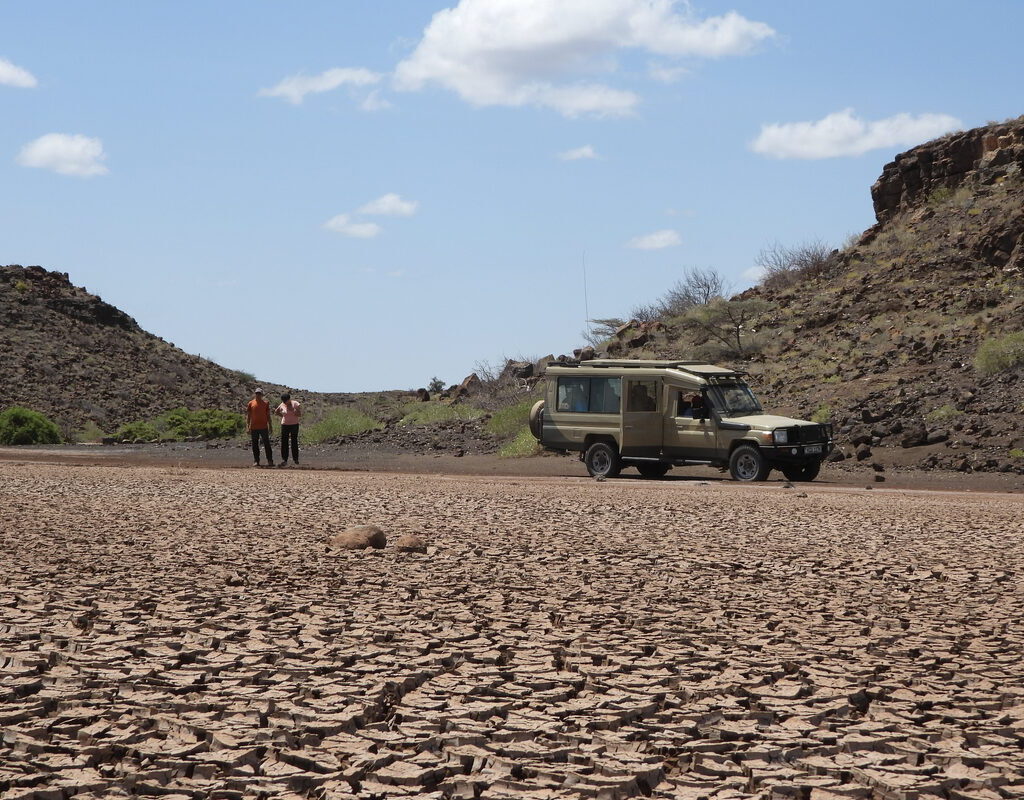
Lake Turkana: The Jade Sea
Lake Turkana is the destination that anchors every northern Kenya safari, and it earns every superlative applied to it.
It is the world’s largest permanent desert lake — 290 kilometres from north to south, between 20 and 50 kilometres wide, and occupying a tectonic basin in the Eastern Rift Valley that stretches across the Kenya-Ethiopia border. Its waters are alkaline and slightly saline, giving them that extraordinary blue-green colour that prompted the name that has outlasted every other description.
The Jade Sea sits in a landscape of dark volcanic rock, harsh scrubland, and massive open sky. The towns and settlements on its shores — Loiyangalani on the southeast, Kalokol on the west — feel like the edge of the world, because in many ways they are.
What makes Lake Turkana so compelling is not just its visual drama. It is the layering of what it represents: an ecological wonder, a human cradle, a living culture, and one of Africa’s most remote and least-visited destinations, all compressed into a single body of water.
The Wildlife of Northern Kenya
Northern Kenya is not the Masai Mara. You will not find the same density of wildlife, the same concentration of predators, or the same volume of game drive traffic. What you will find is something rarer and, for many visitors, ultimately more rewarding: wildlife species that exist nowhere else on a standard Kenya safari itinerary.
The Samburu Special Five
Samburu National Reserve is home to five animal species uniquely adapted to the dry, semi-arid conditions of northern Kenya — species that you simply will not see on a southern circuit safari, no matter how many game drives you do.
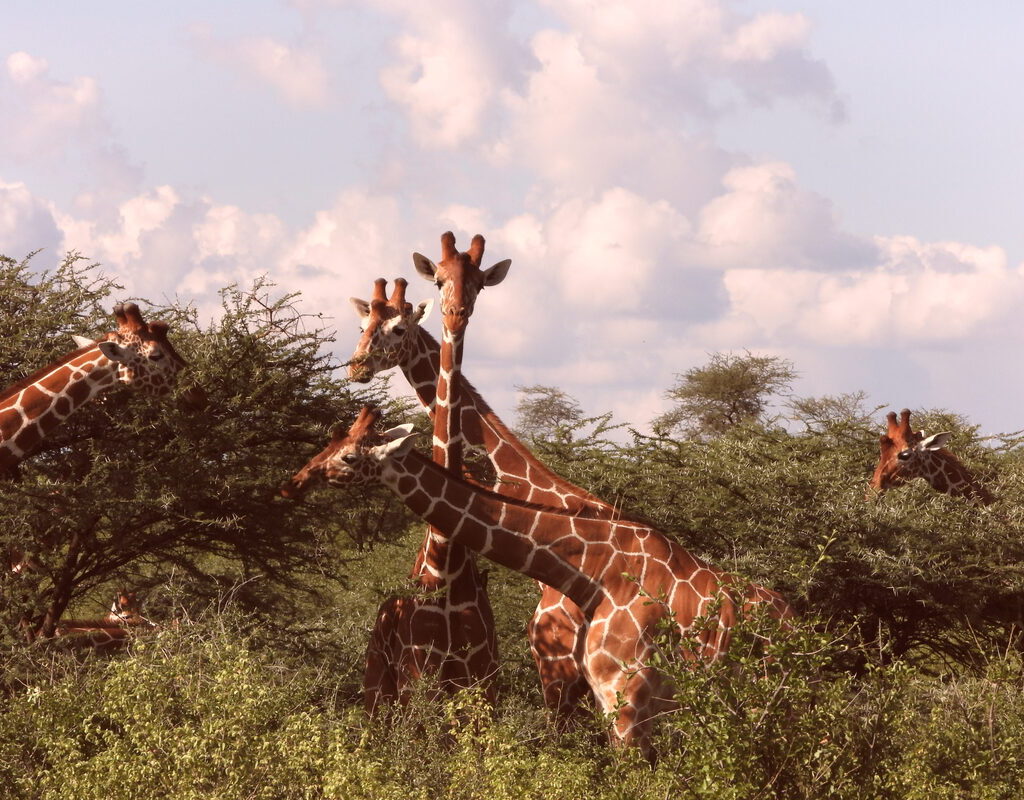
Reticulated Giraffe
The most visually distinctive of all giraffe subspecies, the Reticulated Giraffe has a coat of large, clearly defined chestnut-brown polygons separated by clean white lines — like a stained-glass window rendered in amber and ivory. It is a different animal entirely from the patchier, more faded colouring of the Masai Giraffe found in the south, and Samburu has one of the world’s strongest populations.
Seeing a group of Reticulated Giraffes moving through the fever trees along the Ewaso Nyiro River at dawn — long necks swaying, the early light catching that extraordinary coat — is one of the defining images of a northern Kenya safari.
Grevy’s Zebra
The Grevy’s Zebra is the world’s largest wild equid and one of Africa’s most endangered animals, with a global population estimated at fewer than 3,000 individuals. It is instantly distinguishable from the common plains zebra by its narrow, closely-spaced stripes, large rounded ears (almost donkey-like in their size), and pure white belly — the stripes stop abruptly at the midline, leaving a clean white underside that no plains zebra has.
Samburu is one of the best places in the world to see Grevy’s Zebra. Spotting them alongside the more common plains zebra, which also occurs in the reserve, makes the differences immediately and vividly apparent.
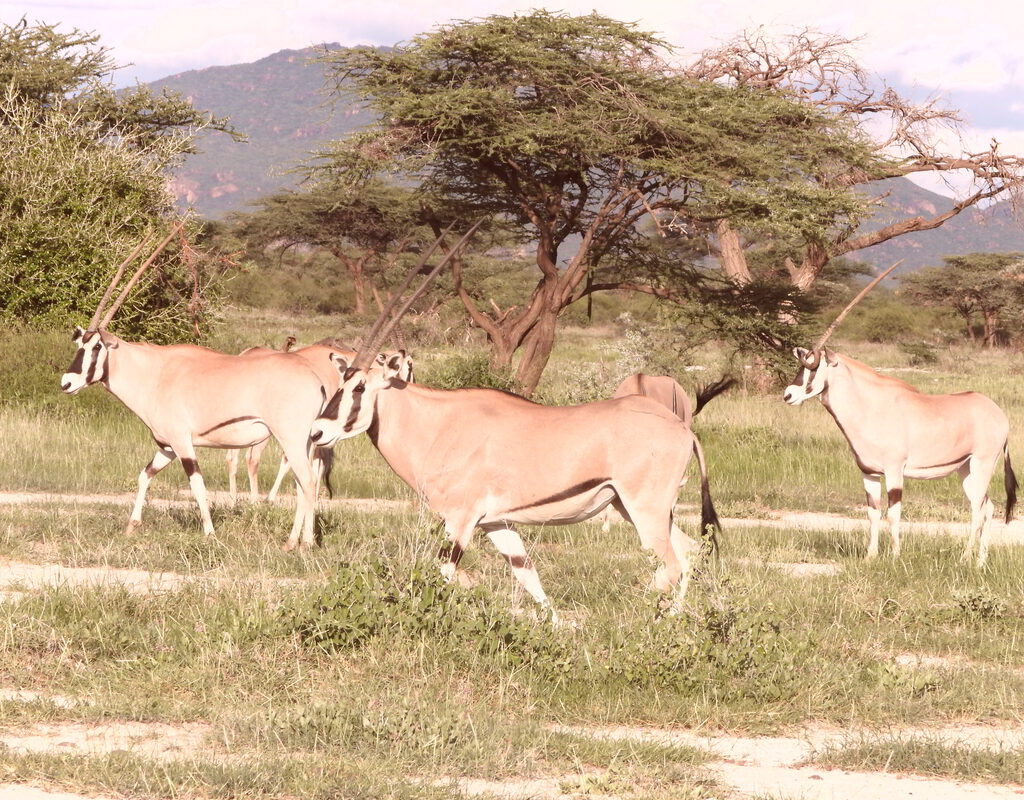
Beisa Oryx
A large, powerfully built antelope designed by evolution for desert survival. The Beisa Oryx has long, straight horns — sometimes over a metre in length — and a striking black-and-white facial pattern that makes it instantly recognisable. Its most remarkable adaptation, though, is physiological: it can raise its core body temperature during the heat of the day to reduce the temperature differential between its body and the surrounding air, dramatically reducing water loss through sweating.
In a landscape where water is scarce and heat is relentless, this ability is the difference between life and death. The Beisa Oryx has been solving the desert survival problem for millennia.
Somali Ostrich
Only recently recognised as a separate species from the Common Ostrich, the Somali Ostrich is endemic to the Horn of Africa region and differs most visibly in the colouring of its neck and thighs — blue-grey rather than pink, and particularly vivid in males during breeding season. Samburu and the dry northern landscapes it leads into are among the best places in Kenya to observe this species.
Gerenuk
Save perhaps the best for last. The Gerenuk — whose name comes from the Somali word for “giraffe-necked” — is a slender, long-necked antelope with the singular habit of browsing while standing fully upright on its hind legs, using its front legs to steady itself against a branch and its extraordinary neck to reach vegetation several feet above what any other antelope can access.
Watching a Gerenuk feeding upright in the Samburu thornbush is one of those wildlife moments that stays with you permanently. It looks simultaneously improbable and perfectly logical — and it is entirely unique to the arid north.
Wildlife at Lake Turkana
Lake Turkana’s wildlife is as distinctive as its landscape. The lake hosts one of the world’s largest populations of Nile crocodiles — an estimated 14,000 animals — concentrated particularly around Central Island and the lake’s northern shores. This is not a population in recovery; it is one of the few places in Africa where crocodile numbers have remained genuinely healthy throughout the twentieth century.
The lake also supports significant populations of hippopotamus, particularly at its northern end near the Ethiopian border. Over 350 bird species have been recorded across the Turkana basin, including enormous flocks of flamingos that gather on the alkaline shallows, vast numbers of migrating waders during the European winter, and specialist species like the African Skimmer and Hemprich’s Hornbill.
Central Island National Park — three volcanic craters rising from the centre of the lake, reachable only by boat — is one of the most important nesting sites for Nile crocodiles in Africa, and also hosts significant seabird colonies and the beautiful African Fish Eagle.
Wildlife at Maralal and Beyond
The landscapes around Maralal, on the return south from Lake Turkana, offer further wildlife encounters in a very different environment — highland savannah where buffalo, zebra, impala, and hyena are commonly seen. The forests around Maralal are also excellent for birdwatching, with Hartlaub’s Turaco, African Crowned Eagle, and numerous forest specialists present.
The People of Northern Kenya
If the landscapes and wildlife are extraordinary, the people of Northern Kenya are what make a safari here truly unforgettable. Five distinct communities live along the northern circuit route, each with a culture, language, and way of life shaped by centuries of adaptation to one of Africa’s most demanding environments.
The Samburu
The Samburu are a semi-nomadic Nilotic people closely related to the Maasai, occupying the semi-arid lands of north-central Kenya around the reserve that bears their name. They are immediately recognisable by their distinctive dress — men in red shukas, women in elaborate layered beadwork necklaces that signal age, marital status, and social standing — and by the warrior culture that gives Samburu society much of its structure and identity.
A visit to a Samburu manyatta (family homestead) is one of the most genuine cultural experiences on the northern circuit. The Samburu have maintained their traditional lifestyle to a remarkable degree — cattle herding remains central to their economy and identity, traditional medicine is widely practised, and the age-set system that governs social roles (from junior warrior through senior elder) continues to organise community life as it has for generations.
What distinguishes a Samburu cultural visit with Ahambi Tours is the relationship. This is not a transaction — we bring you to communities we have known for years, where the welcome is real and the exchange is genuine.
The Gabbra
As you drive north from Marsabit towards the Chalbi Desert, you enter Gabbra territory. The Gabbra are Cushitic-speaking camel herders of Ethiopian origin who have occupied the arid lands between Marsabit and Lake Turkana for centuries, and whose entire culture is built around the demands of desert pastoralism.
Gabbra society is organised around clans and age grades, and their relationship with their camels goes far beyond practical utility — camels are a measure of wealth, a symbol of status, and a central feature of ceremony and spiritual practice. A Gabbra man who loses his camels loses everything that defines him.
Meeting the Gabbra near Kalacha — at the edge of the Chalbi — and sharing an evening of storytelling around a fire under the desert sky is one of the most immersive cultural experiences the northern circuit offers.
The Rendile
The Rendile are one of Kenya’s oldest communities, a Cushitic-speaking people whose oral traditions stretch back thousands of years and whose territory lies in the Kaisut Desert southeast of Marsabit. Like the Gabbra, they are primarily camel pastoralists, and their culture shares many features — the emphasis on mobility, the central role of livestock, the deep spiritual life — while remaining distinctly their own.
Rendile women are known for extraordinary beadwork and distinctive headdresses, and their traditional dress — particularly for ceremonies — is among the most visually striking in all of northern Kenya. A visit to a Rendile community near Lake Turkana gives you access to a cultural world that very few outsiders ever see.
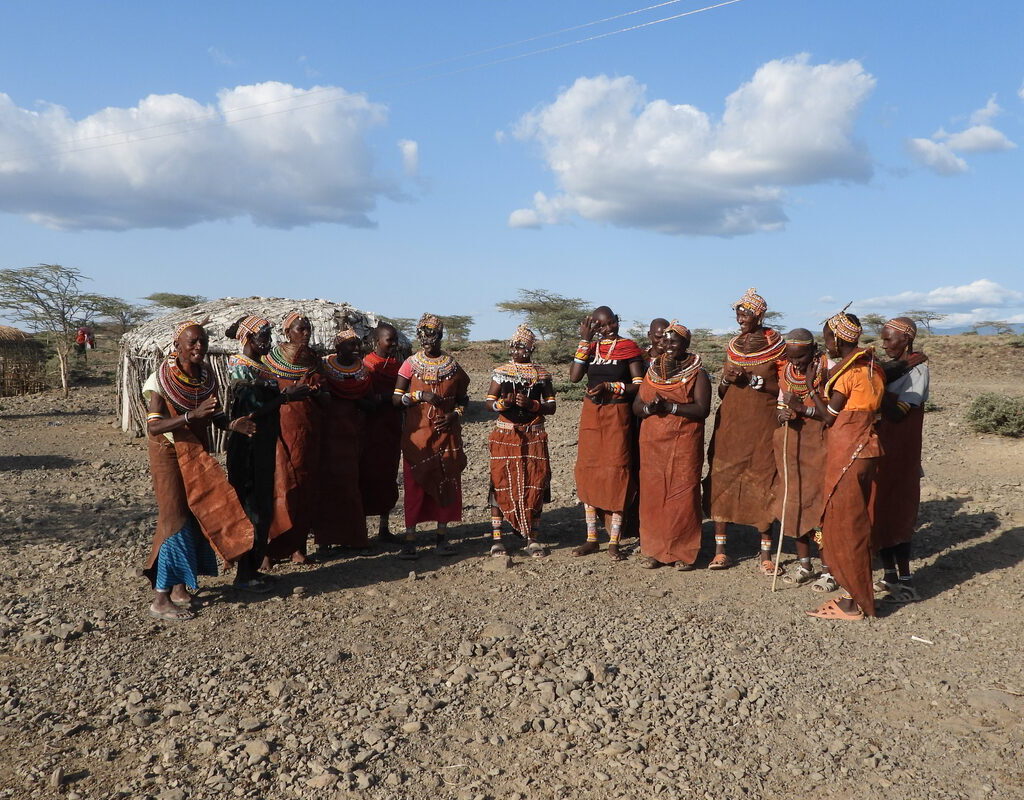
The El Molo
The El Molo are one of Kenya’s smallest ethnic groups and one of Africa’s most extraordinary communities. For generations — no one is quite certain how many — they have lived on tiny islands and the rocky shoreline of Lake Turkana near Loiyangalani, building their settlements from doum palm fronds and volcanic rock, and subsisting almost entirely on fish from the lake and the occasional hippopotamus.
At their lowest point in the twentieth century, the El Molo population fell below 500 people. Today numbers have recovered somewhat, but the community remains small and their traditional way of life is increasingly under pressure from the broader social and economic changes affecting northern Kenya.
Visiting an El Molo village is a privilege and, in some small way, an act of support for a community working to maintain its identity. You see the reed boats used for fishing, the traditional homesteads, the way an entire culture has been built in intimate relationship with a single body of water over an almost inconceivable stretch of time.
The Turkana
The Turkana are Kenya’s second largest ethnic group — a Nilotic people occupying a vast territory in northwestern Kenya that stretches from the shores of the lake that bears their name to the borders with Uganda, South Sudan, and Ethiopia. Turkana culture is organised around pastoralism and, for lakeshore communities, fishing — and their adaptation to the extreme heat and aridity of the Turkana Basin is nothing less than a masterpiece of human resilience.
Turkana women are immediately recognisable by their elaborate beadwork, neck rings, and the decorative clay applied to their hair — a style that has remained remarkably consistent for centuries. Meeting Turkana families in Loiyangalani gives you a window into a culture that has absorbed and survived everything this harsh landscape has thrown at it, and is still standing.
Lake Turkana’s Hidden History
No guide to Northern Kenya would be complete without a mention of what lies beneath the lake — or more precisely, around it.
The Turkana Basin is one of the most significant palaeontological sites in the world. Fossil discoveries made around Lake Turkana over the past sixty years have fundamentally shaped our understanding of human evolution. The region has yielded some of the oldest and most complete hominin fossils ever found, including Turkana Boy — a 1.6-million-year-old Homo erectus skeleton discovered in 1984 that remains one of the most complete early human fossils in existence.
Lake Turkana’s National Parks — encompassing Central Island, South Island, and the Sibiloi National Park on the lake’s eastern shore — are collectively designated a UNESCO World Heritage Site, recognised for both their outstanding natural value and their extraordinary significance to the story of human origins.
This is a lake where, if you stand on the right stretch of shore and look long enough, you are standing at the beginning of humanity. That knowledge adds a dimension to the experience that no other safari destination in Kenya can match.
Stargazing in the Northern Desert
One of the experiences that surprises visitors most on a northern Kenya safari — and that almost no one thinks to put on their list before they arrive — is the night sky.
In Elgade, on the edge of the Chalbi Desert, you are further from artificial light than almost anywhere else in Kenya. On a clear night, the Milky Way is not a suggestion or a smear — it is a solid, luminous arch of stars from horizon to horizon, so bright it casts a faint shadow. The Southern Cross is low in the south. Scorpius blazes directly overhead. Jupiter and Venus, when they are up, are bright enough to read by.
People who have spent their entire lives under the light-polluted skies of cities and towns often experience their first genuinely dark sky in the northern desert — and the effect is profound. There is a reason that every community in this region has a rich tradition of navigating and storytelling by the stars. Standing outside the Umoja Guest House at Elgade at midnight, looking straight up into the full depth of the galaxy, you understand exactly why.
Food and Drink on a Northern Kenya Safari
Northern Kenya is not a destination known for its cuisine, and it would be dishonest to suggest otherwise. But food on a northern safari is one of those things that ends up being more memorable than you expect — not because of what is on the plate, but because of where you are when you eat it.
The first morning in Samburu:
Breakfast arrives as the sun is still low and orange over the Ewaso Nyiro River. Vervet monkeys move through the fever trees above the dining area. An elephant crossed the river overnight and the tracks are still fresh in the mud on the opposite bank. Fresh fruit, eggs, toast, and hot coffee — the simplest meal in the world, eaten in one of the most extraordinary places on earth. That is the template for food on the northern circuit. Context transforms everything.
Most meals throughout the safari are straightforward and satisfying: fresh chapati, rice and beans, grilled nyama choma (roasted meat), stewed vegetables, and ugali — Kenya’s staple maize porridge that becomes genuinely comforting after a long day on a rough road. The portions are generous. The ingredients are as fresh as the supply chain in remote northern Kenya allows, which — particularly for vegetables and fruit in Marsabit’s surprisingly fertile highland environment — is often better than you expect.
Ashnil Samburu Camp:
Where the safari begins, offers the most varied menu of any stop on the route. The camp kitchen is well-equipped, the dining area sits directly on the riverbank, and the combination of good food and extraordinary setting makes every meal there feel like an event. It is worth taking your time at dinner on the first and second nights before the remoteness of the north takes over.
From Marsabit northward:
Meals become simpler. The guest houses at Elgade and Loiyangalani serve honest, filling Kenyan food — the kind that restores rather than impresses. At Loiyangalani, this is also where the lake begins to contribute directly to what is on your plate.
Fresh Nile tilapia and Nile perch from Lake Turkana are sometimes available at small restaurants in Loiyangalani, and if the opportunity arises, take it. Fish pulled from the Jade Sea that morning, fried simply with onions and served with chapati while the lake glitters beyond the restaurant window — this is one of the quiet, unexpected pleasures of the north that guests mention long after they have forgotten the details of their game drives.
Tea is available everywhere and at all times. Kenyan chai — strong black tea brewed with milk and sugar — is the social currency of the north. A cup of chai shared with a Gabbra elder at Kalacha, or offered by an El Molo family in Loiyangalani, is worth more as a cultural exchange than any formal guided experience.
For alcohol, bring your own from Nairobi or purchase in Samburu town. Supplies in the remote north are limited and unpredictable. For drinking water, you need not worry — fresh water is provided throughout the safari by Ahambi Tours.
Photography in Northern Kenya
Northern Kenya is one of East Africa’s great photography destinations, and it is significantly underrepresented in the safari photography conversation — which means your images will be original in a way that Masai Mara lion photographs, however beautiful, simply cannot be.
The light
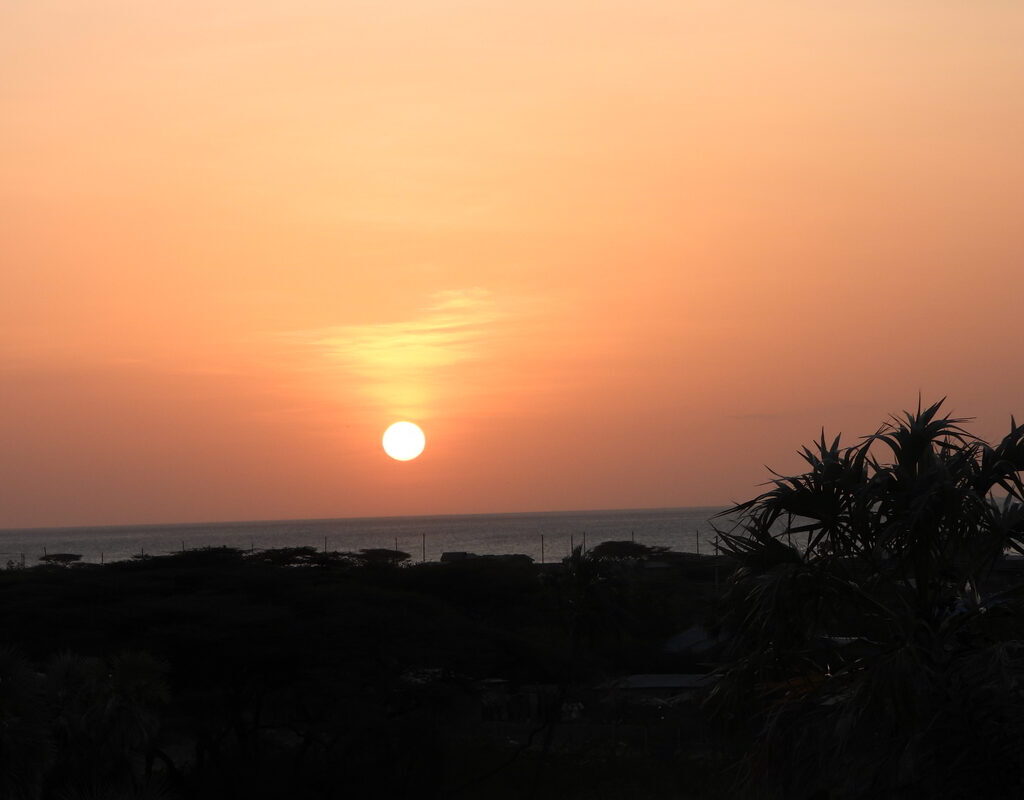
in the north is exceptional. The clean, dry air, the lack of haze common in more humid safari landscapes, and the dramatic interplay of volcanic rock and open sky create conditions that photographers describe as exceptional from first light to golden hour. Sunrise over the Ewaso Nyiro River in Samburu. Midday in the Chalbi when mirages turn the white salt flat into an abstract painting. Sunset over Lake Turkana, the water turning from jade to copper to deep crimson as the sun drops below the western shore.
The people
with their permission and your guide’s facilitation — offer portrait opportunities of extraordinary richness. The beadwork of the Samburu women, the faces of Gabbra elders, the El Molo fishermen on their reed boats, Turkana children running ahead of the vehicle on the road into Loiyangalani — these are images that carry genuine weight and tell real stories.
The wildlife
in Samburu, particularly the Special Five, offers unique photographic subjects that no amount of time in the Mara will give you. A Gerenuk standing on its hind legs against a thornbush sky. A pair of Grevy’s Zebra at the river at dawn. A Beisa Oryx staring directly into your lens with an expression of absolute aristocratic calm.
Practical tips for photographers:
Bring more memory and more batteries than you think you need — charging opportunities in the remote north are limited and sometimes unreliable. A good quality dust-resistant bag for camera equipment is essential; the Chalbi Desert is one of the dustiest environments on earth. Polarising filters are particularly useful for the lake and desert sections where glare is intense. And a lens in the 100–400mm range will serve you well for wildlife in Samburu, while a wide-angle is the right choice for landscapes in the Chalbi and Turkana.
When to Visit Northern Kenya
Unlike some East African safari destinations, Northern Kenya can be visited throughout the year — but the experience varies significantly depending on the season.
Dry Season: June to October and January to March
The dry season months are the most popular for good reason. Roads are accessible, the Chalbi Desert is safely crossable, river levels are low and manageable, and wildlife in Samburu concentrates around permanent water sources making game viewing more productive.
The dry season also means cleaner skies for photography, cooler evenings (particularly at altitude in Marsabit and around Maralal), and the best conditions for the long driving days the northern circuit requires.
June to October is the longer and more reliable dry season, with cooler temperatures and excellent road conditions throughout the route. This is the best time for first-time visitors to the north.
January to March is a shorter dry window between the short rains (November) and the long rains (April–May). Conditions are generally good, wildlife viewing is strong, and visitor numbers are lower than the July–September peak — making this a very appealing window for travellers who prefer quieter experiences.
Green Season: April, May, and November
The long rains (April–May) and short rains (November) bring genuine challenges to the northern circuit. Some stretches of road become impassable, parts of the Chalbi Desert may flood, and logistics require more careful planning.
That said, the green season has its own extraordinary rewards. The Chalbi, when it floods with shallow water, becomes a flamingo paradise of almost surreal beauty. Marsabit’s forests are at their most lush. The landscape around South Horr and the Suguta Valley is startlingly green. And the near-absence of other visitors means those who do make the journey in the rainy season have the entire north almost entirely to themselves.
If you are considering a green season visit, contact us directly. We can advise on current road conditions, adjust the itinerary where necessary, and ensure the experience is everything it should be.
Practical Guide: Everything You Need to Know Before You Go
Getting There
All Ahambi Tours northern Kenya safaris depart from Nairobi. We collect from your hotel or Nairobi airport on the morning of Day 1. Nairobi is served by direct international flights from major hubs including London, Amsterdam, Dubai, Addis Ababa, and Johannesburg.
Visa Requirements
Most nationalities require a Kenya entry visa. Kenya operates an e-visa system — apply online at evisa.go.ke before travel. Processing typically takes 2–3 business days. EAC member state nationals (Uganda, Tanzania, Rwanda, Burundi, South Sudan, DRC) do not require a visa.
Health and Vaccinations
Consult a travel health clinic at least 6 weeks before departure. Yellow fever vaccination is recommended for Kenya and required if travelling from certain countries. Malaria prophylaxis is strongly advised for the northern region, where transmission risk is moderate to high. Carry personal medication and any prescription drugs in sufficient supply — pharmacy options in the remote north are extremely limited.
A hepatitis A vaccination is also recommended for northern Kenya given the remoteness of the region and limited medical facilities en route.
Emergency evacuation cover is included in all Ahambi Tours northern Kenya safaris. We strongly recommend comprehensive travel insurance in addition.
What to Pack
Clothing:
Lightweight, breathable fabrics in neutral tones (khaki, tan, olive, grey) for game drives. Avoid blue and black — these attract tsetse flies in some areas. A warm fleece or jacket for early mornings and higher elevations (Marsabit summit area can be genuinely cold). A waterproof layer if travelling during the green season.
Footwear:
Comfortable walking shoes for village visits and short walks. Sandals for evenings. Closed-toe shoes for game drives.
Sun protection:
High-factor SPF sunscreen (50+), wide-brim hat, UV-protective sunglasses. The northern sun is intense and the altitude at Marsabit offers less atmospheric protection than at sea level.
Equipment:
Binoculars — essential for wildlife viewing and birdwatching. Dust-resistant bags for cameras and electronics. A headtorch or torch for remote accommodation where generators have limited hours. A reusable water bottle (drinking water is provided throughout).
Health kit:
Personal medications, insect repellent (DEET-based for malaria risk areas), hand sanitiser, basic first aid supplies, oral rehydration salts.
Money:
Carry sufficient Kenya shillings in cash for tips, personal purchases, and any activities not included in the itinerary. ATMs are available in Nairobi and Samburu but essentially non-existent further north. USD cash is widely accepted as backup.
Connectivity
Mobile phone signal is available in Nairobi, Samburu, and Marsabit but patchy to non-existent between these centres and in the far north around Lake Turkana. Loiyangalani has limited Safaricom signal. Consider this a feature rather than a problem — one of the great gifts of Northern Kenya is the enforced disconnection from the noise of daily life.
Is Northern Kenya Safe for Tourists?
This is the question that sits at the back of every prospective visitor’s mind, and it deserves a direct, honest answer rather than a vague reassurance.
Yes — Northern Kenya is safe for tourists travelling with an experienced, locally-connected operator.
The context matters, though. Northern Kenya has a complex history. Some areas of the north — particularly border zones near South Sudan and parts of Turkana County far from the safari route — have experienced inter-community conflict and cattle rustling over the years. Kenya’s government and local communities have made significant progress in stabilising these areas, but the remote nature of the north means that independent travel without local knowledge carries genuine risks.
The safari route operated by Ahambi Tours — Samburu, Marsabit, Kalacha, Loiyangalani, Maralal — is a well-established circuit that has been safely operated by our team since 2013. We have deep, long-standing relationships with communities along the entire route. Our drivers and guides are not simply familiar with the roads — they are known by name in the villages we pass through, and those relationships are the foundation of the safety our guests experience.
A few specific points worth knowing:
Samburu National Reserve
is a fully established, well-managed national reserve with a consistent security presence. It is as safe as any major Kenya safari destination.
Marsabit
is the administrative capital of Marsabit County and a functioning regional town with police presence and established accommodation. Security is stable.
The Chalbi Desert and Loiyangalani
are remote, and remoteness itself requires respect. We travel with communication equipment, emergency protocols, and the local knowledge to navigate any situation that arises. We do not take our guests anywhere we would not take our own families.
The return route through Maralal
passes through Samburu County’s administrative capital — a safe, well-connected town with no significant security concerns for visitors.
We monitor conditions along the entire route continuously and will never operate a journey we consider unsafe. If conditions at any point on the route change in a way that affects safety, we reroute or postpone — and we communicate this transparently with guests well in advance.
The honest summary: thousands of travellers have made this journey safely over the past decade, and with the right operator, the risks are no greater than any other remote wilderness safari in East Africa. The key phrase is the right operator. Local knowledge, community relationships, and genuine experience are not optional extras on a Northern Kenya safari — they are the safety net.
Northern Kenya vs Masai Mara: Which Safari Is Right for You?
This is the question we are asked most often, and it deserves a considered answer.
Choose Masai Mara if:
You are on your first Kenya safari. Want to see the Big Five. Visiting between July and October and the wildebeest migration is a priority. You prefer more comfortable, established infrastructure. You want a shorter or more compact itinerary.
Choose Northern Kenya if:
You have done the Mara (or Amboseli, or Tsavo) and want something genuinely different. Fascinated by culture and want to meet communities that most safari visitors never encounter. Photographer looking for original subjects and extraordinary light. Value remoteness and the feeling of genuine expedition over comfort and convenience. Want to see wildlife species — the Samburu Special Five — that a southern circuit safari simply cannot offer.
Choose both if:
You have the time. A combined itinerary — northern circuit followed by a few days in the Mara, or vice versa — gives you the full picture of what Kenya’s extraordinary safari landscape can offer. Many of our guests do exactly this.
The honest answer is that these are not competing destinations. They are complementary ones. But if we are being direct: the Masai Mara will always be there. The Northern Kenya that exists today — the remote roads, the unspoiled communities, the Jade Sea without a crowd — is a finite thing, and the window to experience it as it is right now will not stay open forever.
Why Book Your Northern Kenya Safari with Ahambi Tours
Ahambi Tours was founded in Nanyuki, We are a northern Kenya operator — our base, our guides, our community relationships, and our road knowledge are all built from this region outward.
Have been running northern Kenya safaris since 2013. In that time we have built genuine, lasting relationships with communities along the entire route — relationships that are the foundation of every cultural encounter we facilitate. When a Samburu manyatta welcomes you warmly, or an El Molo fisherman takes the time to show you how a traditional reed boat is built, that welcome is extended in part because of trust that has been built over more than a decade.
Our vehicles are properly equipped 4x4s — not retrofitted or borderline-suitable, but purpose-built for remote northern terrain, maintained to a high standard, and driven by guides who know every stretch of the northern circuit in every season. We carry emergency equipment, communication devices, and the knowledge of how to use them.
KWS-licensed, 5-star rated on TripAdvisor, and Travellers’ Choice Award winners. Not the cheapest option in Northern Kenya. We are the most experienced, the best connected, and the most committed to delivering an experience that is genuinely worth making.
With Ahambi Tours, you are never a stranger.
Book Your Northern Kenya Safari
We operate both 8-day and 10-day Northern Kenya safari itineraries, as well as custom itineraries for travellers with specific interests — extended photography trips, community-focused cultural tours, or combined northern circuit and Masai Mara packages.
8-Day Northern Kenya Safari — from USD 4,750 per person Samburu → Marsabit → Chalbi Desert → Lake Turkana → Maralal → Nairobi
10-Day Northern Kenya Safari — from USD 5,550 per person Samburu → Marsabit → Chalbi Desert → Lake Turkana → Maralal → Nyahururu → Lake Naivasha → Nairobi
Both itineraries are private — your group, your vehicle, your guide.
WhatsApp: +254 725 727 167 Email: [email protected] Website: ahambitours.co.ke
30% deposit to confirm | Balance due 14 days before departure | Deposits valid 12 months
Frequently Asked Questions About Northern Kenya Safaris
How long does a Northern Kenya safari take?
Most northern Kenya safaris run for 8 to 10 days. Eight days covers the core circuit — Samburu, Marsabit, Chalbi Desert, Lake Turkana, and Maralal — comfortably without feeling rushed. Ten days adds Nyahururu’s Thomson’s Falls and a final day at Lake Naivasha, making for a more complete journey. Shorter trips are possible but sacrifice either destinations or the unhurried pace that makes the north so rewarding.
How do you get to Lake Turkana?
Lake Turkana is not reachable by public transport in any practical sense. The standard route for a safari is by road from Nairobi: north through Samburu and Marsabit, then across the Chalbi Desert to Loiyangalani on the lake’s southeastern shore. The entire overland journey from Nairobi to Lake Turkana takes approximately five driving days. Charter flights to Loiyangalani exist but are expensive and remove the journey itself — which is half the experience.
What is the Jade Sea?
The Jade Sea is the popular name for Lake Turkana, derived from the lake’s extraordinary blue-green colour. The colour is caused by Spirulina algae and dissolved volcanic minerals in the alkaline water. Lake Turkana is the world’s largest permanent desert lake and a UNESCO World Heritage Site. The name Jade Sea has been in use since at least the mid-twentieth century and is now the most widely recognised description of the lake internationally.
What animals will I see on a Northern Kenya safari?
The headline wildlife is the Samburu Special Five — Reticulated Giraffe, Grevy’s Zebra, Beisa Oryx, Somali Ostrich, and Gerenuk — found only in northern Kenya’s arid landscapes. Beyond the Special Five, Samburu also has lion, leopard, elephant, cheetah, and crocodile. Lake Turkana is home to one of the world’s largest Nile crocodile populations, hippos, and over 350 bird species. The landscapes around Maralal support buffalo, zebra, and various antelope.
Is Northern Kenya better than the Masai Mara?
They are not comparable in simple terms — they offer fundamentally different experiences. The Masai Mara delivers the highest wildlife density in Kenya, the Big Five, and the wildebeest migration. Northern Kenya delivers remoteness, cultural depth, unique wildlife species, and landscapes found nowhere else. Most experienced Africa travellers consider the north and the south complementary rather than competing. If you can only go once, the Mara is the classic choice. If you have been to the Mara and want to go deeper, the north is the answer.
How much does a Northern Kenya safari cost?
Ahambi Tours northern Kenya safaris start from USD 4,750 per person for the 8-day itinerary (groups of 3 or more) and USD 5,550 per person for the 10-day itinerary. Solo traveller pricing is higher due to the private nature of the safari — one vehicle, one guide, regardless of group size. All safaris include accommodation, meals, park fees, cultural visits, and emergency evacuation cover.
What is the best time of year to visit Northern Kenya?
June to October and January to March are the best months — dry conditions, accessible roads, and strong wildlife viewing in Samburu. April, May, and November bring rains that can make remote roads challenging, though the green season has its own rewards including flamingos on the flooded Chalbi and lush highland scenery.